Education
Socialization in Homeschooling: The Truth
The truth about homeschool socialization: what the research really says, the myths, and practical ways to help your child build real friendships and social skills.
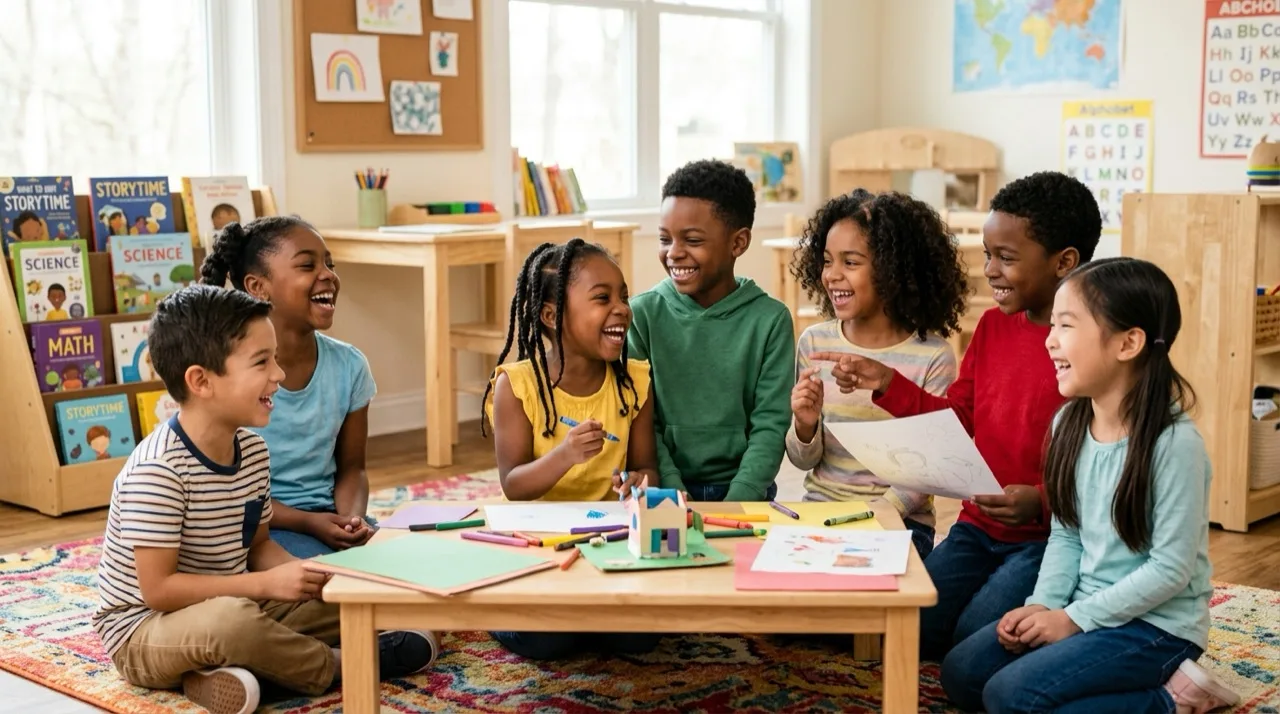
Socialization in Homeschooling: The Truth
"But what about socialization?" If you have told anyone you are considering homeschooling, you have almost certainly heard this question. It is the single most common worry families raise, and it often comes loaded with an image of a lonely child stuck at the kitchen table, cut off from the world. The reality is very different, and it is worth understanding before you let that one question steer a major decision for your family.
Homeschool socialization is not about whether your child spends every day in a building with thirty other kids the same age. It is about whether they learn to relate to people, build friendships, handle conflict, and find belonging. Those skills can grow in many settings, and a growing number of families are proving it. This article walks through what the research actually shows, where the real challenges are, and how to give your child a rich, connected social life outside a traditional classroom.
The Question Behind the Question
When people ask about socialization, they are usually asking two different things at once. The first is "Will my child have friends?" The second is "Will my child grow into a capable, well-adjusted adult who can navigate the world?" These are fair questions, and they deserve honest answers rather than slogans from either side of the debate.
It helps to separate two ideas. Socializing means spending time with others. Socialization means learning the values, manners, and skills you need to function in society. A child can be surrounded by peers all day and still be poorly socialized, and a child can spend more time in mixed-age community settings and become deeply socially capable. The setting matters less than the quality and variety of the relationships in it.
Homeschooling is also more mainstream than many people assume. An estimated 3.4 million school-age children, roughly 6 percent of the K-12 population, were homeschooled during the 2024-2025 school year, and participation has been growing at nearly three times the pre-pandemic rate (Source: National Home Education Research Institute). This is no longer a fringe choice, and the social infrastructure around it has grown with it.
What the Research Actually Says
Here is the part that surprises most people. The body of research on homeschool socialization is broadly positive, not negative.
Reviews of the available studies find that homeschooled students generally show healthy social, emotional, and psychological development, and many studies report above-average outcomes (Source: National Home Education Research Institute). Some research suggests homeschooled children report higher quality friendships and notably stronger relationships with their parents and other adults than peers in conventional schools (Source: Coalition for Responsible Home Education).
Long-term outcomes are reassuring too. A study by Hamlin and Cheng found that while some homeschool graduates experienced a kind of "culture shock" when they entered adult life, they were generally well connected later on, active in mainstream institutions, and showed no meaningful disadvantage in college experience, marriage, or employment (Source: Coalition for Responsible Home Education).
The honest caveat is that much of this research relies on self-reports from homeschooling families rather than neutral, third-party assessment, so it should be read with healthy caution. And outcomes are not uniform. One survey of more than 3,700 homeschool graduates found a minority, roughly a quarter, who described their own socialization as poor or very poor (Source: Coalition for Responsible Home Education). That mixed picture is actually the most useful takeaway of all.
The Real Takeaway: It Depends on the Approach
The data points to one clear conclusion. Homeschooling does not automatically produce socially thriving children, and it does not doom them to isolation either. Outcomes depend almost entirely on what the family actually does.
Children who are intentionally connected to co-ops, sports, clubs, faith communities, volunteer work, and regular time with friends tend to flourish. Children who are kept at home with few outside relationships are the ones who struggle. In other words, isolation is a risk you can manage, not a built-in feature of homeschooling. This is genuinely good news, because it means socialization is something you can design on purpose.
Practical Ways to Build Strong Social Skills
You do not need to recreate a school hallway to raise a socially confident child. You need consistent, varied, real human contact. Here are the building blocks that work.
Join a Co-op or Learning Community
Homeschool co-ops and microschools have expanded rapidly. More than half of the microschools operating nationally function as homeschooling cooperatives, where families learn together several times a week (Source: National Microschooling Center). These communities give children regular peers, shared projects, group discussion, and the everyday give-and-take of working alongside others.
Pursue Activities That Mix Ages
Sports teams, theater, music ensembles, scouting, chess clubs, and church or community youth groups all teach cooperation, leadership, and how to handle winning and losing. Mixed-age settings are a quiet advantage of homeschooling. Children learn to lead younger kids and learn from older ones, which mirrors the real world far better than a room sorted by birth year.
Build in Service and Real-World Interaction
Volunteering, a part-time job for older teens, helping at a food bank, or running an errand and talking to the cashier all count. These ordinary moments teach children to interact respectfully with people of every age and background, which is the heart of true socialization.
Be Consistent, Not Just Occasional
Friendship grows from repetition. A weekly class, a standing park day, or a regular team practice does far more than a one-off outing. Put social connection on the calendar the same way you schedule math, and protect that time.
How Family World School Helps
This is exactly where a structured community changes everything. Family World School is a values-driven online homeschool cooperative, not a marketplace and not a do-it-all-alone arrangement. It is built around belonging.
Children join live online classes led by vetted educators, so they learn alongside the same familiar faces week after week and build genuine relationships rather than studying in isolation. The cooperative model means families are part of one connected community with a shared sense of values, mainly serving African American and continental African families while remaining open to all. There is one flat, transparent monthly fee, so you can plan your child's full social and academic year without surprises. The result is the thing parents worry they will lose by homeschooling: real friendships, real mentors, and a real community where a child is known.
The Bottom Line
The fear that homeschooling means social isolation is mostly a myth, and the research backs that up. What the evidence really shows is that socialization is a choice you make, not a side effect of where your child sits during the day. Families who stay intentional, plugging into co-ops, activities, service, and consistent community, tend to raise children who are confident, kind, and ready for the world.
If you are weighing homeschooling and the socialization question is what is holding you back, the best next step is to see a connected community in action. Explore Family World School's live classes and cooperative programs, or book a short consult to talk through what social life could look like for your child. You may find that the question you were most afraid of has one of the most encouraging answers of all.